The history of computers spans thousands of years, evolving from simple counting tools to today’s powerful digital devices.
Early Computing (Before 1800)
- Abacus (c. 2500 BCE): One of the earliest tools used for arithmetic calculations.
- Mechanical calculators (1600s): Invented by people such as Blaise Pascal and Gottfried Wilhelm Leibniz to perform mathematical operations.
The Age of Mechanical Computers (1800s)
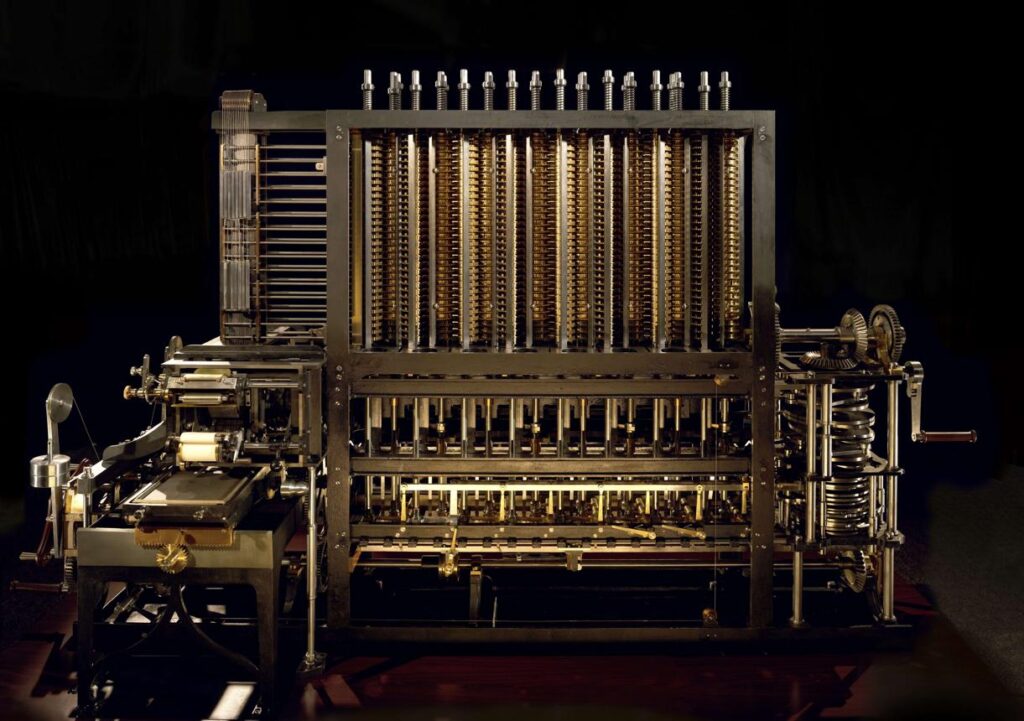
- Charles Babbage designed the Difference Engine and the Analytical Engine, earning him the title “Father of the Computer.”
- Ada Lovelace wrote what is considered the first computer algorithm, making her the world’s first computer programmer.
First Generation (1940–1956)
- Computers used vacuum tubes for processing.
- They were very large, expensive, and consumed a lot of electricity.
- Examples include ENIAC and UNIVAC I.
Second Generation (1956–1963)
- Transistors replaced vacuum tubes.
- Computers became smaller, faster, more reliable, and used less power.
- Programming languages such as COBOL and FORTRAN became popular.
Third Generation (1964–1971)
- Integrated Circuits (ICs) replaced individual transistors.
- Computers became more compact and efficient.
- Operating systems and keyboards became common.
Fourth Generation (1971–Present)
- The invention of the microprocessor led to the rise of personal computers.
- Companies such as Apple Inc., IBM, and Microsoft played major roles in popularizing personal computing.
- Laptops, smartphones, and tablets emerged.
Fifth Generation (Present and Future)
- Focuses on Artificial Intelligence (AI), machine learning, quantum computing, robotics, and cloud computing.
- Modern computers can recognize speech, understand natural language, and solve complex problems.
Summary Timeline
| Period | Major Development |
|---|---|
| Ancient | Abacus |
| 1600s | Mechanical calculators |
| 1800s | Babbage’s Analytical Engine |
| 1940s | Vacuum tube computers |
| 1950s | Transistor computers |
| 1960s | Integrated circuits |
| 1970s–Today | Microprocessors and personal computers |
| Present–Future | AI and quantum computing |
The evolution of computers has transformed society by making communication, education, business, healthcare, scientific research, and entertainment faster and more efficient.